
Now these are the gifts Christ gave to the church: the apostles, the prophets, the evangelists, and the pastors and teachers. Their responsibility is to equip God’s people to do his work and build up the church, the body of Christ (Ephesians 4:11-12, NLT).
When I was a kid my brother and I were constantly outdoors in the great boreal Canadian forest, scaling Precambrian magmatic rock that had been scrapped bare by ancient glaciers and sudden flooding from the days of Noah. Much like the rough land of scraggly spruce and pines harboring a plethora of birds, bugs and bears, us kids from the north were accustomed to the environments variety of difficulties and adapted our characters to match the natural challenges. The variegated landscape helped us to develop keen awareness, while sudden swings in the weather taught us to be resourceful. Nature, depicted as a mother, is also a ruthless tyrant at times and toughens both body and soul. Adding teamwork to the three aforementioned virtues allowed us to accomplish much as our bored minds hadn’t yet access to smartphones.
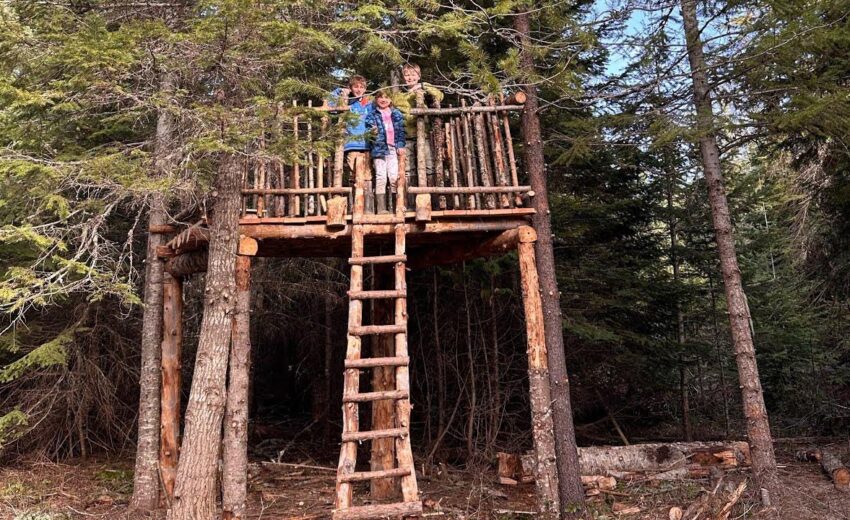
One of our great accomplishments (for a kid at least) was the building of tree forts. Trees and vegetation in general were always more than at a surplus in our neck of the woods – it being not so much a forest but rather a cold jungle with bodies of water of all shapes and sizes dotting the land like a craggy shoreline full of glistening pools. You could readily build and then abandon as many tree forts as you liked with plenty of untouched land at your disposal. Resources were never the issue. Building a good tree fort that would last was always the problem.
Comparing the building up of a church with the necessary virtues for the construction of a tree fort shows us some startling similarities. Our need for keen awareness to understand the lay of the land can easily be translated into the lived experiences of our current cultural context as both presently known in real time and remembered from yesteryear. Each church, figuratively speaking, will be constructed in different ways by necessity. Leadership principles, personality, history, and the ongoing needs of the congregation will dictate the form a church takes just as land will partially determine the type of tree fort built. Stopping to survey what we actually have rather than what we want, once had or think we ought to have, develops a keen awareness which will in turn aid our ongoing quest to “equip God’s people”.
Resourcefulness, an old-timey and now mostly wayward virtue, is a splendid alternative to the ever attractive myth of the silver bullet. It’s also a productive cure of the ever burgeoning slothfulness of our current zeitgeist. Jesus employed this advantage in the Gospels as a matter of habit and nearly to a fault. Think back to the time temple taxes were to be payed or when thousands needed to be fed. In both cases a miracle was wrought through the efforts of resourcefulness when abundance was apparently lacking. As John puts it, “He existed in the beginning with God. God created everything through him, and nothing was created except through him” (John 1:2-3). We often forget the practical applications of these theological truths and seek easy gain through the resourcefulness of others via books and speeches laden with stories of failure and triumph. Perhaps a program will be of us? Or, perhaps the Holy Spirit has already built a program within the heart of each believer and it need be caught and brought out as the coin was from the fishes mouth or asked and given as fish and loaves to the hungry. Your keen awareness as well as time itself will determine what it means to be resourceful with whatever you’ve been given as the weather often dictated the building of our tree forts.
I recall a particularly low moment in my life when I was a fairly new pastor and had run up against a host of difficulties that pressed in with unusual persistence and subtlety. Problems that are straightforward are usually easily addressed. These, however, seemed to come from the periphery, which is difficult to attend to when regular responsibilities are unrelenting. In short, I was discouraged. It was a good friend who simply reminded me to “not become weary doing good” when I confided in him, relating my depleted state and overall confusion of the matter (Galatians 6:9a). Essentially he told me to try again, a toughening statement we tell children all the time with nearly everything. It was precisely what I needed to hear and something we ought to tell ourselves often when building up the church. Wasn’t it the same sort of thing needed for Israel as they wandered in the wilderness or for Jeremiah when he was belittled and ignored or for Daniel when facing persecution and political traps or for Ruth, widowed and in a foreign land? Sometimes life is easy but most of the time it’s tough and must be handled with tough-love, as does the building of a fort when a platform is on the verge of collapse and the mosquitoes are unrelenting.
The conversion story of the Apostle Paul is generally noted for its supernatural occurrence, rightly giving glory to Jesus. We pay witness to His divine power and grace as a matter of fact and tradition in our preaching and teaching throughout the centuries as a point of evangelism, but sometimes forget that Paul’s story is also one of teamwork. It was Ananias of Damascus who was instructed to “go over to Straight Street, to the house of Judas” to pray and lay hands on “a man from Tarsus named Saul” so that he would no longer be blind (Acts 9:11-12). Ananias was hesitant to do so because of Paul’s past atrocities against the early church, telling the Lord in such words He was convinced otherwise that it was indeed the will of God to use Paul for the sake of the Gospel. Teamwork is far from the pleasantries of the half hour sitcom that resolves divisions with a quick turn in the attitude in the placid background of a laugh track. Teamwork happens when we as Christians choose to do it for the Kingdom of God regardless of our opinions and preconceived notions. My childhood friends and I worked together on many a tree fort with and without grudges and hurt feelings.
Our call is to “build up the church”. Keen awareness, resourcefulness, toughness, and teamwork will go along way in this noble en devour and will build you up too, for you are part of the same church. When you build you are also being built. The tree forts of my childhood have long deteriorated after decades of successive winters and harsh changes in the environment. They are of this world whereas the church is “the body of Christ” and meant for eternity. What is built in you and I by Christ will carry on forever.
Let us build the church!
Pastor Aaron